
Guide, published 5 November 2026
How NightlyIQ Prices a Night: Base Price, Gap Nights and Minimum Stays
What each setting does, how NightlyIQ treats it, and what it does not do. Written by Jordan Pham. Updated 5 November 2026.
The short version
Two apartments in the same building can have the same layout and still book very differently. Getting the price and the stay rules right for each one is what pricing software is for. NightlyIQ, the pricing software BNB Success built for its members, looks at each property’s own results against its local market, then recommends settings to review: a base price, discounts for gap nights, and minimum stays.
Quick answer: NightlyIQ prices a night in three steps. It compares your property with its local market, recommends a base price and adjustments, and then suggests stay rules, such as discounted gap nights and the right minimum stay. You review and apply each change. NightlyIQ then tests it over a set window and compares your results with the market.
NightlyIQ is BNB Success’s pricing software. It launched on 2 June 2026 and is open to every BNB Success member.
It compares each property’s occupancy, booked rate and booking pace with its local market, using data from PriceLabs, a third-party data source.
The base price is the starting nightly rate. NightlyIQ recommends changes to it, plus adjustments for days of the week, events, advance bookings and last-minute bookings.
A gap night is an unbooked night between two reservations. NightlyIQ can recommend a discount for these, because a gap nobody can book earns nothing.
A minimum stay is the fewest nights a guest can book. A longer one means fewer turnovers. A shorter one means more bookings, and more cleaning.
Each recommendation shows the data behind it and comes with a testing window. At the end, NightlyIQ compares the property with its market.
NightlyIQ 1.0 recommends settings. The operator reviews and applies them. It does not guarantee results.
What is NightlyIQ?
NightlyIQ is a pricing intelligence platform for short-stay operators. BNB Success built it alongside its education and operating programs, and the first version launched on 2 June 2026. At the time of its launch announcement on 30 September 2026, it analysed more than 600 properties each night. It is open to every BNB Success member.
Where the data comes from
It uses property and competitive-set data from PriceLabs. PriceLabs is a third-party data source and pricing tool. BNB Success has said this does not indicate a partnership or endorsement.
What version 1.0 does
NightlyIQ 1.0 recommends settings that an operator can review and implement. A later version that would apply recommended settings automatically is in development and is not part of 1.0. More on the software is on the technology page.
How NightlyIQ looks at a property
NightlyIQ starts with three measures for each listing: its occupancy, its booked rate and its booking pace. It compares each one with the property’s local market, which it calls the competitive set. The comparison matters more than any single number. A property that is 70% booked looks fine on its own, but not if the market around it is 90% booked.
Each property is assessed individually. In the words of Jordan Pham, two properties with similar layouts can produce different booking results. A rule that suits one apartment can be wrong for the one next door.
NightlyIQ also tracks listing impressions, views and bookings. That helps show where prospective guests leave the booking process. It matters because a price problem and a listing problem can look the same on a calendar.
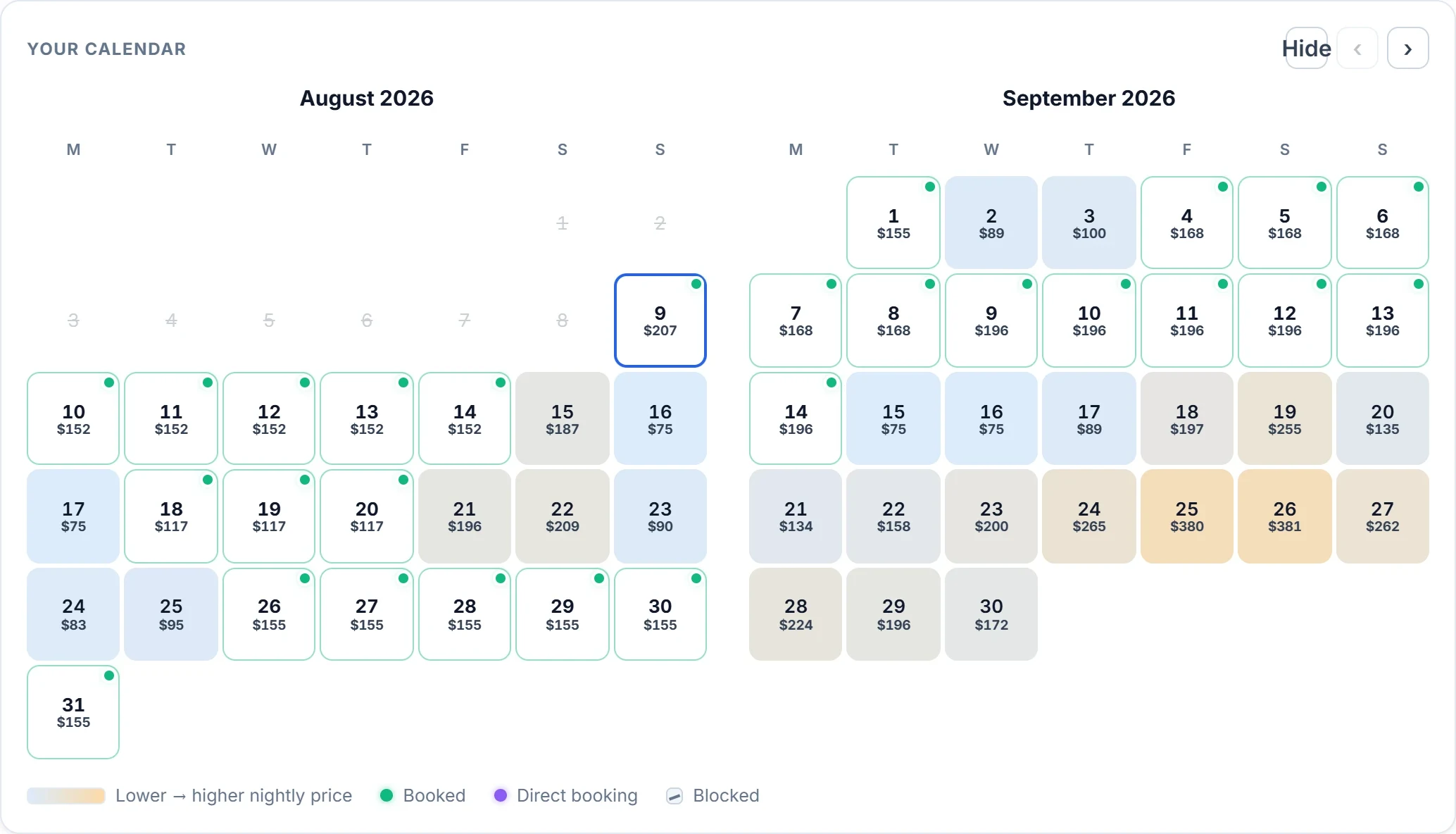
The three settings, side by side
What each one controls, the trade-off it carries, and what NightlyIQ recommends for it.
Base price
Controls: the starting nightly rate that other adjustments build on. Trade-off: too high leaves nights empty, too low gives revenue away. NightlyIQ recommends: base-price changes, plus day-of-week, event, advance-booking and last-minute adjustments.
Gap nights
Controls: unbooked nights between two reservations. Trade-off: a discount fills the gap, but must still cover the cost of the turnover. NightlyIQ recommends: gap-night discounts.
Minimum stay
Controls: the fewest nights a guest can book. Trade-off: longer means fewer turnovers, shorter means more bookings. NightlyIQ recommends: minimum-stay changes.
Each setting in detail
1. Base price
The base price is the nightly rate that everything else starts from. If it is too high, the calendar stays empty. If it is too low, nights book quickly but earn less than they could. NightlyIQ recommends base-price changes by comparing the property’s booked rate and booking pace with its market.
A single base price rarely stays right all year, because demand changes by day and by date. NightlyIQ can also recommend day-of-week adjustments, and separate pricing for events, advance bookings and last-minute bookings.
2. Gap nights
A gap night is an unbooked night between two reservations. Take a standard minimum stay of three nights. One guest checks out on the 14th and the next checks in on the 16th. That leaves two nights, the 14th and the 15th, which nobody can book under a three-night minimum. A gap rule lets those nights be booked on a shorter stay, and often at a lower rate, instead of staying empty.
The catch is the turnover. Every stay needs a clean and fresh linen, so a discounted gap night only helps if the rate still covers those costs. Filling every gap is not the goal. Filling the gaps that pay is. NightlyIQ recommends gap-night discounts, and the operator decides whether to apply them.
3. Minimum stays
A minimum stay is the fewest nights a guest can book. A longer minimum means fewer check-ins and cleans, but it blocks short trips and creates gaps like the one above. A shorter minimum attracts more guests, but adds turnovers.
The right number changes with the season, the day of the week and how close the date is. NightlyIQ recommends minimum-stay changes alongside price. The two affect each other, so they are best reviewed together.
How a change gets tested
A price or a rule can look right or wrong after a day or two for reasons that have nothing to do with the change. NightlyIQ presents the data behind each recommendation and sets a testing window for assessing it. At the end of the window, it compares the property’s performance with its market. That comparison is what shows whether the change helped, and it stops an operator from judging a change on a lucky or unlucky weekend.
What NightlyIQ does not do
It does not change prices on its own in version 1.0. The operator reviews and applies each recommendation.
It does not guarantee more bookings or more revenue. It recommends settings and shows the evidence.
It does not rely on one rule for every property. It assesses each listing against its own market.
It is not a PriceLabs product. It uses PriceLabs data, and BNB Success has said there is no partnership or endorsement.
Using these ideas today
You do not need NightlyIQ to start thinking this way. Five checks help any operator.
Compare your base price with similar listings in your area, for the same dates.
List the gap nights in the next 60 days, and note which ones nobody can book under your current minimum stay.
Work out the lowest gap-night rate that still covers a clean, laundry and supplies.
Review your minimum stay by season and day of the week, not as one number for the year.
Change one setting at a time, and give it a fair window before you judge it.
From Jordan
“Two properties with similar layouts can produce different booking results, even within the same building. NightlyIQ evaluates each property’s results individually and gives operators specific settings to review.”
Jordan Pham, Co-founder, BNB Success
From the NightlyIQ 1.0 launch announcement, 30 September 2026.
How BNB Success helps
This is the ground we cover with BNB Success members. The Mentorship teaches you to find, set up and run short-stay properties on leased property, and NightlyIQ is the pricing software that comes with it. See the BNB Success programs for how it works.
If you are weighing up whether short stays are realistic for you, our free training walks through the whole path, the same one we use ourselves. For the model itself, read how to build an Airbnb business without owning property, and Jordan’s breakdown of what it costs to start an Airbnb on a lease in Melbourne.
FAQs
What is NightlyIQ?
NightlyIQ is BNB Success’s pricing intelligence platform for short-stay operators. It compares each property’s results with its local market and recommends settings the operator can review and apply.
What data does NightlyIQ use?
It uses nightly property and competitive-set data to assess each listing’s occupancy, booked rate and booking pace against its market. The data comes from PriceLabs, a third-party data source. BNB Success has said this is not a partnership or an endorsement.
Does NightlyIQ change my prices automatically?
No, not in version 1.0. It recommends settings, and the operator reviews and applies them. A later version that automates this is in development.
What is a gap night?
A gap night is an unbooked night, or a short run of nights, between two reservations. If it is shorter than your minimum stay, nobody can book it unless a gap rule allows it.
What is a minimum stay?
It is the fewest nights a guest can book. Longer minimums mean fewer turnovers. Shorter minimums mean more bookings and more cleaning.
Should I discount my gap nights?
Sometimes. A discount helps when the rate still covers the turnover costs, such as cleaning, laundry and supplies. If it does not, an empty night can be better than a booked one.
How long should I test a change?
Long enough to compare your results with the market. That is why NightlyIQ sets a testing window for each change instead of judging it after a few days.
Does NightlyIQ guarantee more bookings or revenue?
No. It recommends settings and shows the data behind them. Results depend on the property, the market and the season.
Who can use NightlyIQ?
NightlyIQ is open to every BNB Success member.
Start with the free training.
Watch it first. If it sounds like you, apply and book a call with our team. We’ll talk through your budget, your time and which state you’re in.